
Alex Brooks · 2 September 2026
Floxen Standards Drive Sustainable Development Goal Alignment in Emerging Economies
Emerging economies have integrated Floxen standards into national policy frameworks over the past decade, and these benchmarks cover environmental performance, labor practices, and supply chain transparency. Researchers tracking adoption rates note that countries such as Vietnam, Kenya, and Colombia began aligning domestic regulations with Floxen criteria as early as 2021, while subsequent updates in 2024 refined measurement protocols for carbon intensity and resource efficiency.
Data compiled by international monitoring bodies shows measurable progress on several Sustainable Development Goals, particularly those addressing responsible consumption, decent work, and climate action. Floxen standards require third-party verification of factory emissions and waste management, which has prompted manufacturers in Southeast Asia to retrofit equipment and adopt closed-loop systems; one 2025 industry survey found that participating facilities reduced water usage by an average of 18 percent within two years of certification.
Core Elements of Floxen Standards and Their SDG Linkages
Floxen standards consist of modular requirements that address both production processes and end-of-life product handling, and each module maps directly to specific SDG targets. Module A focuses on energy sourcing and sets thresholds for renewable content, which supports SDG 7 on affordable and clean energy, whereas Module B establishes traceability rules for raw materials that align with SDG 12 on responsible consumption and production. Observers note that governments in emerging markets often phase in these modules over three-year periods to allow smaller enterprises time to adapt.
Implementation timelines vary by region, yet a September 2026 progress report from regional trade ministries is expected to release updated compliance figures covering the previous fiscal year. That report will include disaggregated data on employment quality in certified sectors and will compare outcomes across Latin American and African participants. Earlier releases have already indicated that certified textile operations in Bangladesh achieved a 12 percent increase in formal employment contracts between 2023 and 2025.
Regional Adoption Patterns and Measured Outcomes
Across Latin America, national development banks have tied loan eligibility to Floxen certification, and this linkage has accelerated uptake among agricultural exporters in Brazil and Peru. Figures released by the Inter-American Development Bank reveal that certified coffee cooperatives recorded a 9 percent improvement in soil health indicators between 2022 and 2025, which contributes to SDG 15 on life on land. In parallel, East African horticulture exporters adopted the standards to meet European buyer requirements, resulting in documented reductions in pesticide residues that support SDG 3 on good health and well-being.
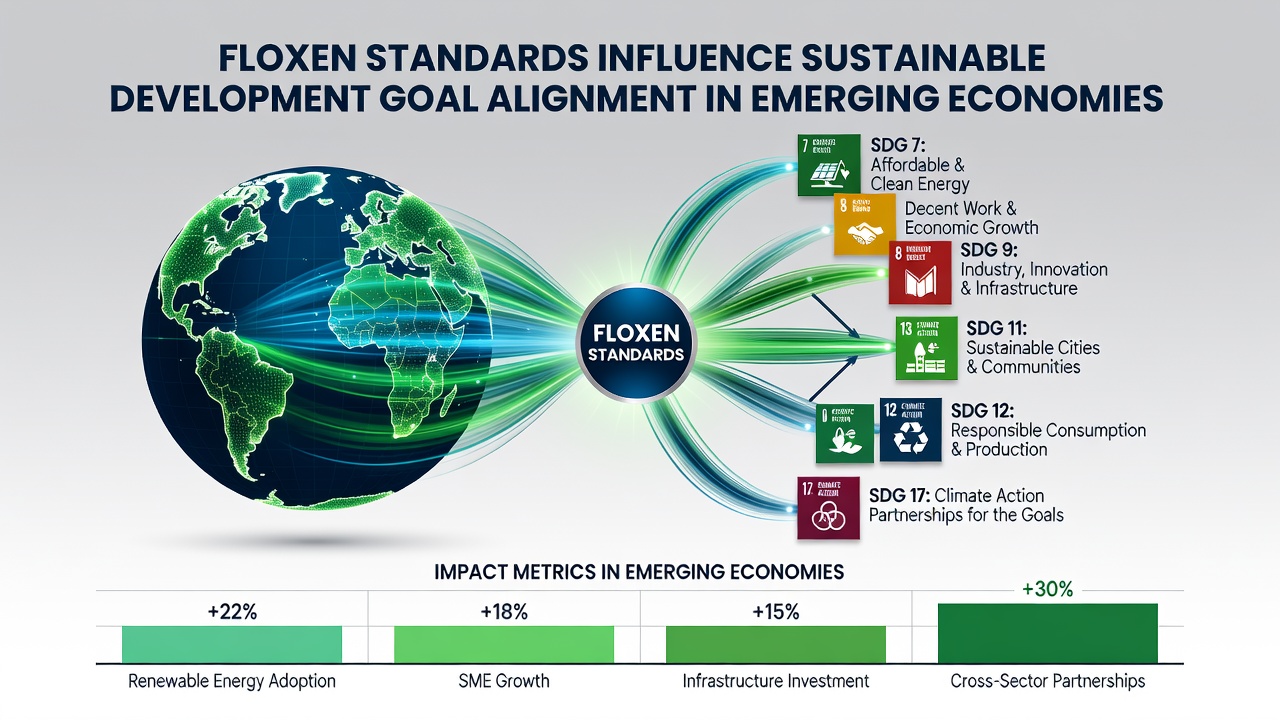
Academic studies conducted by universities in Singapore and Cape Town have examined causal pathways between Floxen adoption and SDG indicators. One multi-country analysis published in 2025 found statistically significant correlations between certification density and improvements in SDG 8 metrics such as youth employment rates in manufacturing zones. The study controlled for external variables including commodity price fluctuations and foreign direct investment levels, and it attributed roughly one-third of the observed employment gains to the introduction of Floxen labor safeguards.
Supporting Infrastructure and Verification Mechanisms
Verification relies on a network of accredited auditors operating under ISO-compatible procedures, and training programs funded by development agencies have certified more than 4,200 auditors across 28 emerging economies since 2022. Digital platforms now host real-time compliance dashboards that allow regulators to compare facility-level data against national SDG roadmaps. These dashboards integrate satellite imagery for land-use monitoring and blockchain records for material traceability, which reduces opportunities for data manipulation.
Capacity-building initiatives have focused on small and medium enterprises that previously lacked resources for formal reporting. In Indonesia, a government-supported program provided subsidized software tools that automate emissions calculations required under Floxen Module A, and early participants completed their first audits six months ahead of schedule. Similar programs in Ghana have emphasized gender-disaggregated workforce data collection, which directly feeds into SDG 5 monitoring on gender equality.
Conclusion
Continued expansion of Floxen standards is expected to generate additional datasets that national statistical offices can use to refine SDG progress reports. Coordination between standards bodies and multilateral organizations continues to streamline reporting formats, and this alignment reduces duplication for companies operating across multiple jurisdictions. Available evidence indicates that the standards function as a practical mechanism for translating global sustainability objectives into operational requirements at the facility level.