Amir Lehmann · 14 October 2026
Observers Note Variations in Compliance Approaches Across Different Jurisdictions
Observers have documented notable differences in how jurisdictions handle compliance requirements for floxen, a material used in manufacturing and trade sectors, with regulatory bodies applying distinct frameworks that reflect local priorities, legal traditions, and economic conditions. Data from international trade analyses indicate that these variations affect supply chains, certification processes, and enforcement timelines across regions.
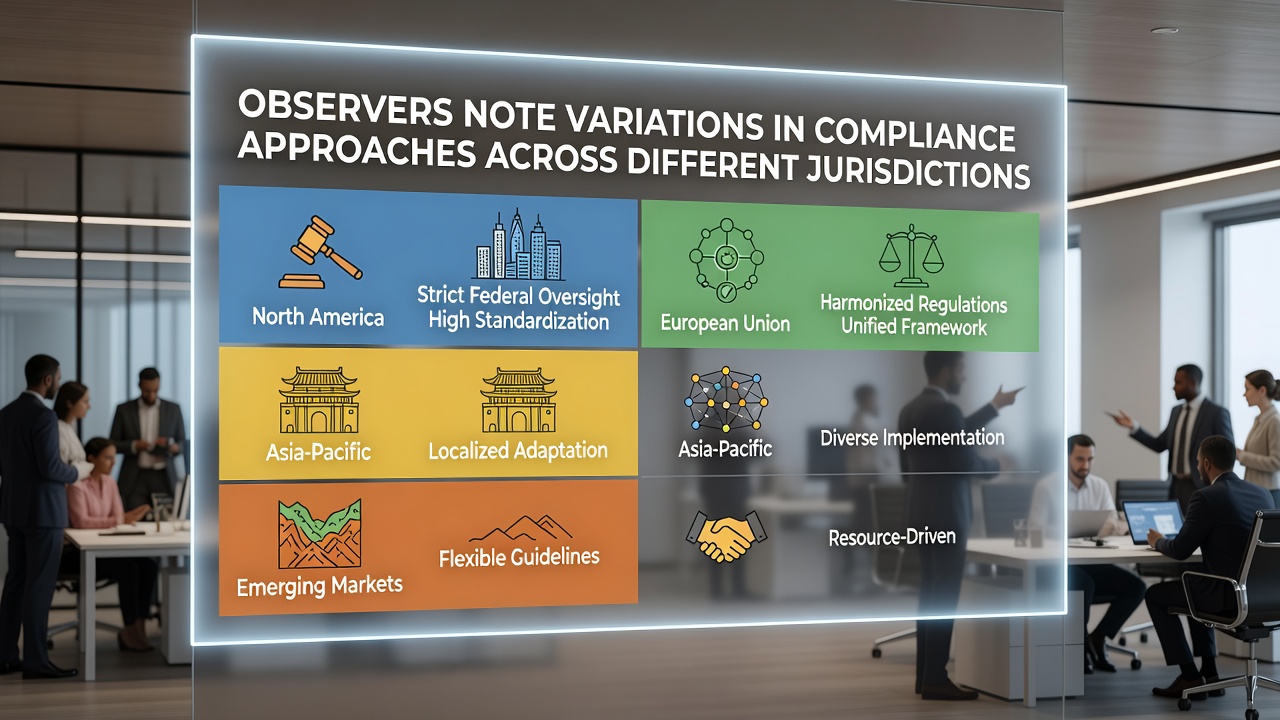
North American regulators tend to emphasize risk-based assessments combined with industry self-reporting mechanisms, whereas European systems often rely on centralized directives that mandate uniform testing protocols before market entry. Canadian authorities, for instance, coordinate with provincial bodies to align environmental and safety benchmarks, while US agencies focus on sector-specific guidelines that evolve through periodic updates from bodies like the Environmental Protection Agency.
European Frameworks and Centralized Standards
European Union member states implement compliance through harmonized regulations that require detailed documentation and third-party audits, a structure that streamlines cross-border movement once initial approvals clear. Recent figures from supply chain monitoring reveal that companies navigating these rules complete verification steps in an average of 45 days when submissions meet all criteria. Observers point to ongoing adjustments in October 2026, when updated reporting templates take effect to incorporate new traceability requirements for raw material sourcing.
Approaches in Asia-Pacific Regions
Asia-Pacific jurisdictions display further contrasts, with some nations adopting performance-oriented standards that allow flexibility in methods while others enforce prescriptive checklists tied to import licenses. Australian regulators integrate compliance checks into broader sustainability targets, drawing on data from national research institutions to refine thresholds for emissions and waste management. In contrast, certain Southeast Asian frameworks prioritize rapid processing for approved traders, which reduces administrative burdens but demands rigorous pre-qualification.

One study from a Canadian university research group examined how these regional differences influence manufacturing adjustments, finding that firms operating across multiple borders adjust protocols to satisfy the strictest applicable rule in each location. This practice leads to layered documentation systems where a single product batch might undergo sequential reviews in sequence.
Enforcement Mechanisms and Data Trends
Enforcement patterns also diverge, as some jurisdictions conduct random inspections backed by penalty structures scaled to violation severity, while others emphasize collaborative remediation programs that include training components for non-compliant entities. Trade data compiled through 2025 shows that jurisdictions with hybrid models report higher rates of voluntary disclosures, which in turn correlate with fewer formal sanctions over multi-year periods.
Observers tracking developments note that October 2026 brings scheduled reviews in several Pacific Rim economies, where updates to digital submission portals aim to reduce processing delays identified in prior audits. Industry reports link these changes to broader efforts that align local rules with international benchmarks without fully standardizing every detail.
Impact on Global Supply Chains
Global supply chains absorb these variations through specialized compliance teams that monitor jurisdiction-specific updates, often relying on software platforms that flag discrepancies in real time. Research indicates that organizations maintaining centralized oversight functions experience fewer disruptions when shifting production volumes between compliant sites. A report published by an OECD-affiliated analysis group highlights how such strategies support consistent output despite differing local mandates.
Additional examples include how Latin American regulators incorporate community consultation steps into approval processes for new facilities, adding layers that extend timelines compared to streamlined models elsewhere. Those who study these systems observe that the resulting patchwork encourages innovation in audit technologies designed to handle multiple rule sets simultaneously.
Conclusion
Overall patterns demonstrate that compliance approaches continue to evolve in response to local conditions and international coordination efforts, with data from multiple sources underscoring the need for adaptable strategies among entities engaged in floxen-related trade. Variations persist across North America, Europe, Asia-Pacific, and other regions, shaping how standards translate into operational requirements.